

Glute Bridge Workout: Why Core and Glute Strength Work Together
Most people train the parts of their body they can see in the mirror. Biceps. Shoulders. Abs in the crunching, grinding, six-pack-chasing sense of the word. And there is nothing wrong with any of that, except that it tends to skip the foundational work that actually determines how well your body functions across your entire life. The deep core, the glutes, and the hips, working in coordination with each other, are the difference between a body that holds up under real demands and one that quietly accumulates compensation patterns until something gives. Strength balance built on this foundation is not a fitness trend. It is the most practical investment you can make in what your body can do.
Here is what that actually means in daily life. It means getting up off the floor without bracing for it. It means hiking a trail without your lower back filing a formal complaint halfway up. It means playing with your grandkids on the ground and standing back up with ease. It means your athletic performance, whatever form that takes, having a stable platform to build on rather than a wobbly base that leaks energy and invites injury. Did you know that most of the physical limitations people experience as they get older are not inevitable? They are the accumulated result of foundation work that never happened.
This post covers why deep core strength, glute strength, and hip mobility are most powerful when they are developed together rather than in isolation, what actually goes wrong when one of the three is missing, and what a personalized workout plan looks like when it builds this foundation deliberately from the ground up.
Why Deep Core Strength Is Not What Most People Think It Is
When most people hear "core training" they picture crunches, planks held for as long as possible, and that particular expression of suffering that fitness culture has decided means you are working hard. That approach trains the superficial abdominal muscles reasonably well. It almost entirely skips the deep core, which is the system that actually matters for everything we are talking about in this post.
The deep core is a pressure management system. It includes the transverse abdominis, the pelvic floor, the diaphragm, and the multifidus muscles of the spine. These structures work together to create stable intra-abdominal pressure that protects the spine during load, transfers force between the upper and lower body, and gives the glutes and hips a stable platform to generate power from. When this system is working well, movement feels organized and efficient. When it is not, the body compensates, usually by overloading the lower back, the hip flexors, or the superficial abdominals in ways that create the chronic tightness and discomfort that so many people have come to accept as normal.
Deep core training looks different from what most gyms teach. It is breath-coordinated, low-load, and highly intentional. It is the exhale that creates a gentle gathering below the navel before any loaded movement. It is the awareness of rib position and pelvic position before adding weight. It is teaching the system to activate automatically and appropriately rather than bracing as hard as possible and hoping for the best. This kind of work is not exciting from the outside. It is the difference between a foundation and a facade, and it shows up in everything.
A body transformation that includes this layer of work produces results that look and feel different from one that skips it. The strength is more accessible. The movement feels cleaner. The body stops spending energy guarding things it does not trust and starts using that energy to actually perform.
What Glute Strength Actually Does for Your Body
The glutes are the largest muscle group in the body and one of the most chronically underused, particularly in people who spend significant portions of their day seated. This is not a minor inconvenience. The glutes are the primary driver of hip extension, which means they are the engine behind walking, running, climbing stairs, standing up from a chair, and every athletic movement that involves pushing the body forward or upward. When the glutes are not doing their job, something else steps in to do it, and that something else is almost always the lower back or the hip flexors, neither of which were designed for that workload.
Glute strength in the context of strength balance is not about aesthetics, though that comes too. It is about hip stability in single-leg positions, which is most of real life. Walking is thousands of single-leg repetitions per day. Every step you take requires the standing-leg glute to keep your pelvis level while the other leg swings through. When that stability is present, the whole system moves efficiently and without pain. When it is absent, the pelvis drops, the lower back compensates, the knee tracks inward, and the chain of small mechanical insults adds up over months and years into the kind of chronic pain that gets blamed on aging.
Developing glute strength that actually transfers to real life requires training in positions that challenge single-leg stability, loading the hip hinge pattern progressively, and building the connection between the glutes and the deep core so that they work as a coordinated team rather than independently. A glute bridge with a genuine connection to the core feels completely different from one performed by squeezing hard and hoping. That difference is not subtle, and it is exactly the difference that makes strength balance functional rather than cosmetic.
Why Hip Mobility Completes the Foundation
Strength without mobility is a ceiling. You can build impressive force in a limited range, but the moment life asks you to move outside that range, the system has no resources to draw on. Hip mobility is what allows the strength and stability you have built to actually express itself across the full arc of human movement, whether that is a deep squat picking something up off the floor, a full stride on a hiking trail, or the rotation required to swing a golf club or throw a ball without your lower back absorbing forces it was not meant to handle.
The hips are the most mobile joint in the body after the shoulder, and they are designed to move in multiple directions, not just forward and back. Rotation, extension, flexion, abduction, all of these directions matter, and most people have significant limitations in at least one or two of them that they have simply learned to work around. The workarounds are where injuries live. When the hip cannot rotate freely, the knee compensates. When the hip cannot extend fully, the lower back compensates. When the hip cannot load in a single-leg position with stability, everything above and below compensates.
Hip mobility training that actually transfers to improved function is active, not passive. It is not sitting in a stretch and waiting. It is moving through range slowly and with control, building the strength in those ranges that tells the nervous system they are safe to access. This is where hip mobility and deep core strength and glute strength all converge, because each one depends on the other two to function at its best. The core provides the stable base. The glutes provide the power and single-leg stability. The hip mobility provides the range through which that power can express itself. Remove any one of the three and the other two are limited by the gap.
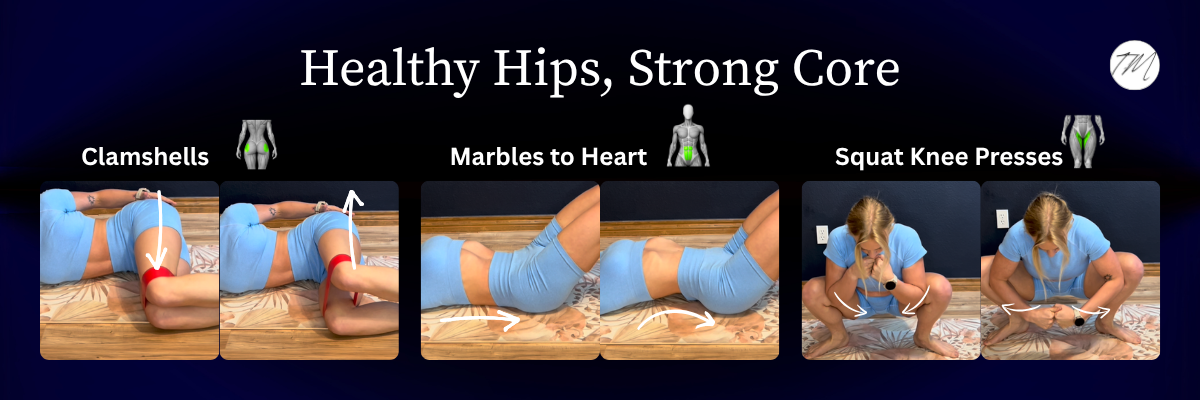
Three Daily Exercises That Start Building Your Foundation Today
Tiffany Mercer is a personal fitness coach specializing in custom training programs built around how you actually live. This is the face of coaching that meets you where you are and builds from there.
You do not need a full program to start. These three exercises can be done daily, require minimal equipment, and directly address the deep core, glute, and hip mobility connection we have been talking about. Done consistently, they build the kind of foundation that makes everything else in your training more effective.
Banded Clamshells
Place a light resistance band just above your knees. Lie on your side with your hips stacked, knees bent to about 45 degrees, and your bottom arm extended under your head. Your spine should be in a neutral position, not arched or rounded. Before you move, take a breath in and on the exhale, gently engage your deep core as though you are zipping up from the inside. Keeping your feet together and your pelvis completely still, rotate your top knee upward toward the ceiling as far as you can go without your hip rolling backward. Pause for one second at the top, then lower slowly with control. The work is in the glute, not the lower back. If you feel your pelvis rocking, reduce the range until you can keep it still. Aim for 10 to 15 repetitions on each side.
Marbles to Heart
Lie on your back with your knees bent and feet flat on the floor, hip-width apart. This exercise trains the deep core and pelvic floor coordination that the rest of your foundation depends on. Inhale slowly through your nose and allow your belly and pelvic floor to soften and expand. On your exhale, imagine you are picking up a marble with your pelvic floor and drawing it slowly upward toward your heart. This is a lift and inward draw, not a hard squeeze or a bearing down. It should feel subtle and controlled, not forceful. Hold the lift for two to three seconds at the top while continuing to breathe, then slowly release on the next inhale. Repeat 10 times. This is the deep core activation cue that makes every other exercise in this section more effective when you keep it running in the background.
Squat Knee Presses
Stand with your feet slightly wider than hip-width and your toes turned out slightly. Hold a light object like a small ball or your fists pressed together at chest height. Lower into a squat position, keeping your chest tall and your weight distributed evenly through your feet. At the bottom of the squat, place your elbows on the inside of your knees and gently press your knees outward against the resistance of your elbows while your elbows press back in. This isometric push-and-resist creates activation in the hip external rotators, the deep glutes, and the inner thighs simultaneously, while the squat position trains hip mobility under load. Hold the press for three to five seconds, release, and stand back up with control. Aim for 8 to 10 repetitions. If the squat depth is uncomfortable, elevate your heels slightly on a folded towel until your hip mobility allows more range.
These three exercises together address all three pillars of the foundation: the deep core coordination from marbles to heart, the lateral glute stability from clamshells, and the hip mobility and rotational control from squat knee presses. Ten minutes daily is enough to start creating real change, and the compounding effect over four to six weeks is significant.
Building the Foundation That Makes Everything Else Possible
The fitness goals that most people bring into a training program, running farther, lifting heavier, moving pain-free, staying active into their seventies and eighties, all of them are downstream of this foundation. You do not need to choose between training for performance and training for longevity. A well-built foundation serves both, because it builds the kind of strength that is available under real conditions, not just in the controlled environment of the gym on a good week.
This is also the foundation that makes the grandkids-on-the-floor moment possible. Not as a metaphor. Literally. The ability to get down onto the floor and back up again with ease and confidence is a direct measure of hip mobility, glute strength, and deep core function working together. It requires rotation, single-leg stability, hip extension, and trunk control all in one movement. It is one of the most honest tests of how the foundational system is actually functioning, and it is something worth training for explicitly rather than hoping it remains available by default.
A personalized workout plan built around this foundation does not require hours in the gym or complicated equipment. It requires consistent attention to the right inputs in the right order, and it pays back in ways that compound across years and decades. If you want to build this foundation with a structured approach that progresses appropriately and accounts for where you are starting from, I would love to work with you on it. Head to tiffanymercer.com/contact for a free consultation with zero pressure. We will look at where you are, what you want your body to be able to do, and what a plan that builds toward that actually needs to include.
